Wednesday, March 18, 2015

MU Campus Connection, Vol. 6- LICM Field Trip

Yesterday was an exciting day for Class2-H, as we took our learning on the road!  The second grade visited the Long Island Children's Museum for some hands-on, inquiry-based explorations.  We were able to get our hands "dirty" in four unique experiences during the field trip.  It was such an amazing time, we didn't even feel as though we were learning!  That's the true hallmark of quality teaching and learning...it's authentic and fun!!  So, we wanted to share the joy of education with you too!  Check out the action!  As you can see, we are all smiles!!

Here we are meeting our guide Paula and learning all about building structures using planks.  Being architects involves patience and problem-solving.  We all had different ideas for various types of buildings, but we worked together to construct fantastic structures.


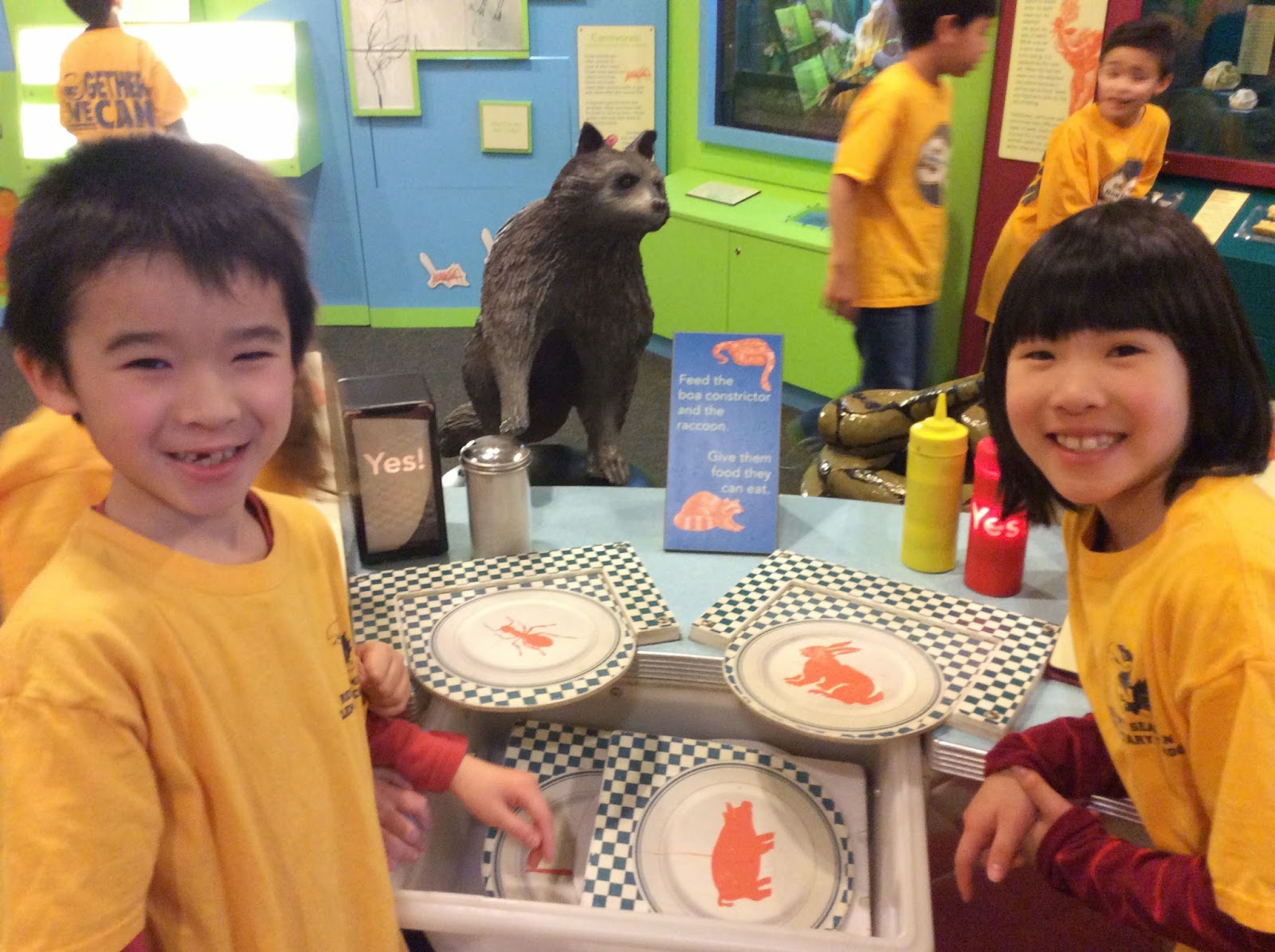
After building works of art, it was time to bring our learning to life with a little biology!  Paula guided us to remember the differences between carnivores, herbivores, and omnivores.  We then had the opportunity to get up close and personal with examples of each (even though some were not alive)!  First, we met Franklin.  He's a box turtle who eats both plants and animals, which makes him an...omnivore!  Next, it was off to the races, as we explored other animals' diets.  Hungry for more pics?!


Soon it was time for the experience EVERYONE was talking about...bubbles!  Don't forget- bubbles are ALWAYS spheres no matter the shape of the wand!!  Here we are using all different types of wands to create bubbles.  And the bubble mania does NOT have to end at the LICM.  The museum was generous enough to share their bubble recipe with us.  The secret ingredient list will be coming home today :)  Enjoy!!


Our bubbles burst once our time in the Bubble Lab ended.  However, we were bubbly once again when we headed over to Healthyville.  This quaint "town" taught us all about healthy living choices.  From exercise, to food, to hygiene, we realized it's up to us to help keep our bodies healthy.  


What a fabulous morning we had at the Long Island Children's Museum!  Even though we didn't get to explore every experience the museum had to offer, we can always come back another day.  The LICM is located near Nassau Coliseum on Museum Row.  This is a wonderful day trip for families and is even appropriate for Pre-K children.  You may want to check it out on the next rainy weekend!

Thanks for sharing in our learning with us.  Please stop by our blog next month to peruse our newest MU Campus Connection!  Class 2-H bids you farewell for now!


Friday, January 30, 2015

MU Campus Connection Vol. 5

Another month has gone by here in Room 27!  For the past few weeks, we have been immersed in everything non-fiction!  Not only have we been reading non-fiction and discussing various text features that help us to better understand expository texts, our wonderful writers have also been collecting data for their upcoming Animal PowerPoint presentations!  We thought we'd walk you through the process of informational writing, so that you too can see how different non-fiction writing is from narrative writing.  The process has been long and arduous, but our end products are destined to be a technological feat (once we create them)!  Enjoy our "virtual animal safari" below to get a glimpse of how non-fiction writers work!

Before the holiday break, each of us made a list of the top three animals that we'd like to learn more about.  From that list, Ms. Hofmann located an expository text on one of our chosen animals.  Each book was individualized by animal and level.  When we came back from the break, we received our books.  Now, it was time to "get to know" our animals!  Here we are getting up close and personal with our animals, as we Post-It interesting facts learned to share with the class.  The unbridled excitement was palpable.  Can you feel the energy too??!!
Watch out Ethan!!!  You may need a bigger boat!

Josh can't wait to share python info!

Why the face Ryan?  Don't you swallow frogs whole too?!

Don't let that vampire bat near your neck Logan!

Ava is using a flow diagram to better understand a dolphin's life cycle!  Text Features rock!

Mia is clearly thrilled to learn where cheetahs live!

After discovering our animals, it was time to use headings to guide us through the note-taking process.  Our headings included Appearance, Habitat, Diet, Babies, and Fun Facts.  As we recorded facts gleaned from our reading, we tried to remember that we don't need to use complete sentences when using bullet points.  We also attempted to put facts in our own words so as not to copy the author directly.  It's okay if we did though!  Note-taking is challenging!!!  Here we are engrossed in our studies!!
Jessy includes a text feature in her illustration...a map!

Cole wrapping his head around the habitat of a boa constrictor!

Kevin putting the final touches on his great white illustration!

Souma, how do gila monsters give birth?

Arion needs TWO pages to record all of his facts about jaguars growing up!

Ryan- How can you possibly focus with all of those baby spiders on your desk?!

Ever swim with the dolphins Sophia?

Phew!  Using books to research was fantastic!  We used the Table of Contents, Glossary, Index, headings, captions, and other text features to deeply understand our learning.  However, this is the 21st century!  Let's collect a few more details using online databases.  Pebble Go is perfect for grade 2!

During library, Mrs. Mattern gives us a quick tutorial on how to use Pebble Go.

Rebecca diligently listens and reads about hammerhead sharks to hammer home her points!!

Meera- don't fall down the rabbit hole!

Kevin- that great white looks hungry!  I hope you don't look like a seal to him!

Once we collected all of our data, it was time to revise and edit our work to make it even better!  Our audience has high expectations, and we wouldn't want to disappoint!  So before we start creating our PowerPoints, we must use a checklist to assist us during the revision and editing processes.  Then we will conference with a teacher to polish our writing. We will hopefully learn a new writing tip or two when we meet with an adult!  Remember, use a colored pencil to show exactly how you improved your piece!!

Madeline carefully combing through her writing.  Love the focus!

Max is systematically ordering his bullet points by importance!

Ellen meticulously marks up her rough draft to improve her piece!
As soon as we finish our edits, it will be time to transfer our information from the graphic organizers to the computer.  On Monday, we will choose our PowerPoint backgrounds/templates and begin work on our title slides.  Though we know it will be a LONG, LONG, LONG time before our PowerPoints are finally published, we are ready to tackle the challenge!

Speaking of tackling, we hope you enjoy Sunday's Superbowl game!  Go Seahawks!  

We will be back soon with another MU Campus Connection!


Wednesday, December 17, 2014

MU Campus Connection Volume 4- Oreo Moon Phases

Another month has "orbited" by here in Room 27!!  Class-2H has been having an absolute blast during our Astronomy Unit.  We've been learning all about our solar system, planets, the sun, the moon, and constellations.  This week, we've been focusing on the moon.  Not only have we been immersed in both fiction and non-fiction texts about the moon, we've been stretching our scientific thinking to learn specifically about the phases of the moon. 

What shape does the moon take in the night sky?  Full moon, half moon, crescent...  different shapes you say? Well, all of these varying shapes are called phases of the moon.  No, the moon doesn't actually change shape.  It just reflects different amounts of sunlight based on the positions of the sun, the earth, and the moon.    

And why is this important for us here on Earth?  Well, us humans organize time based on the natural motions of the earth and the moon.  It takes about a MOONth (month) for the moon to complete one, single revolution around Earth.  During this monthly cycle, the moon goes through phases that repeat each month.  Check out a wall calendar to see if it marks the phases of the moon to show the repeating monthly pattern!

In order to demonstrate this abstract concept of the moon's phases, Class-2H used Oreos to represent the cyclical pattern of the phases of the moon!  What an awesome hands-on discovery activity, if you don't eat your moons!!  Here we are, super engaged, as we sculpt our Oreos to create the phases of the moon!  Room 27 is full of amazing astronomers :)


First, we had to prepare our phases on a plate.  We used a plate to highlight the cyclical nature of the moon's phases and because the moon is round!!  Be careful, don't let your hands get too close to the burning hot sun!!


Our astronomers have partially completely their Oreo moon phases at this point!  Even though Houston had a few problems with scraping off the correct amounts of icing, we all landed safely back on Earth in the end!  Can you find the full moon, new moon, and half moons on Sophia's model??  Is that also a crescent moon in her hand??!!


After completing our lunar mission, our excited astronauts showed off their hard work from space!  We even learned all about the waxing and waning phases of the moon!  I wonder if NASA has any job applications for Class-2H?!  We are ready for lift-off!!!


Sweet models!!!  They look good enough to eat ;)  We can't wait to use our moon models tomorrow to continue to examine the moon's patterns and learn more about the phases of the moon.  Astronomy rocks in Room 27!  I love my "team" of astronauts so much that I'd go to the moon and back for them!!

Class-2H wishes you and your families a happy holiday and a healthy new year!!!  See you back on our class blog in 2015!!